Mr. Dent Collision Repair Publishes Auto Body Repair Guidance for Bolivar Drivers After Road Debris Damage
Ozark, MO - October 21, 2026 - PRESSADVANTAGE - Mr. Dent Collision Repair has published new consumer guidance outlining
Press Release Disclaimer: This is a press release distributed through the XPR Media network. It has not been independently verified by our newsroom.
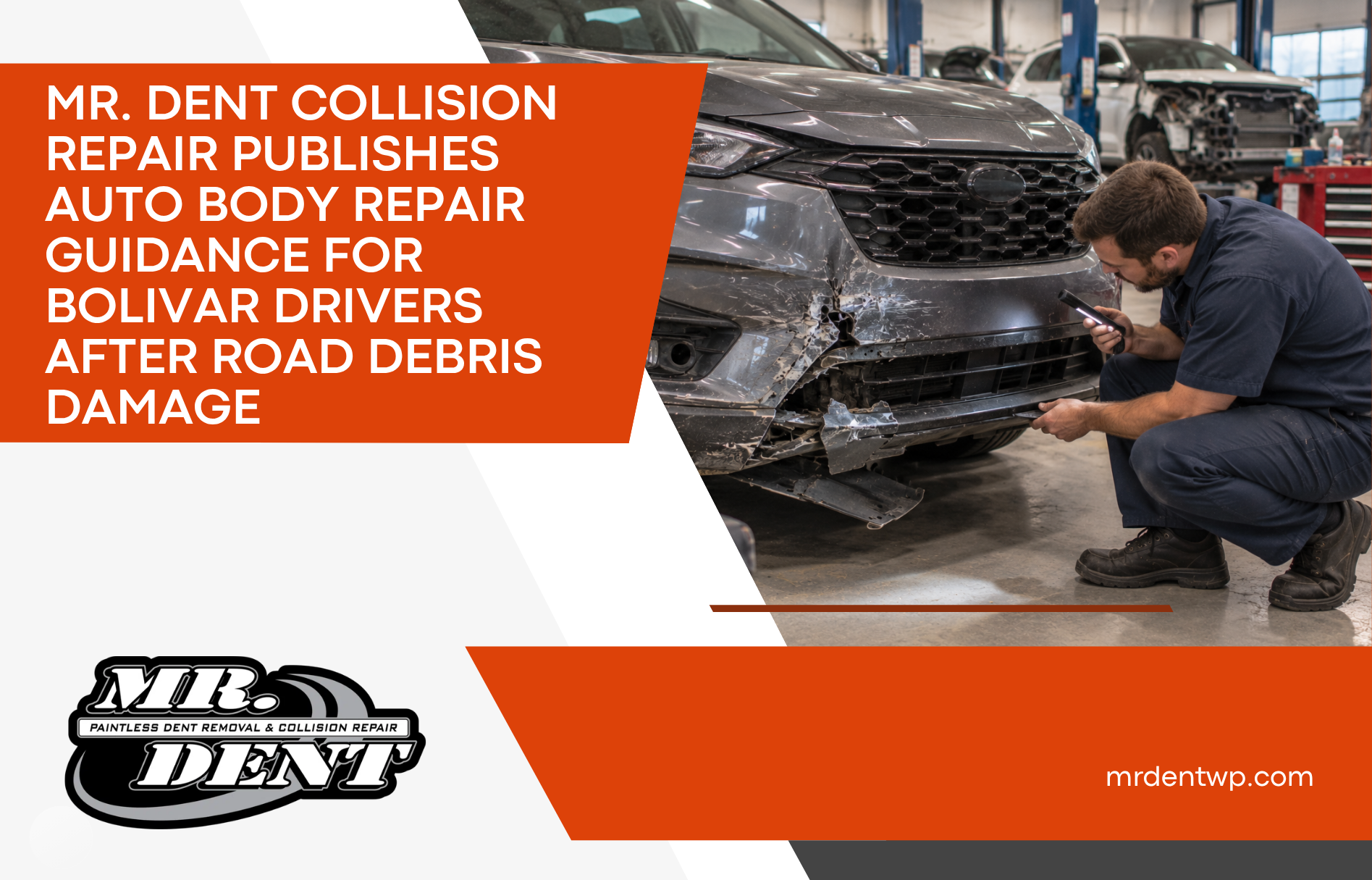

Ozark, MO – October 21, 2026 – PRESSADVANTAGE –
Mr. Dent Collision Repair has published new consumer guidance outlining how road debris damage can be evaluated according to the surface or component affected rather than the visible size of the impact alone. The October publication introduces a three-part framework covering paint and exterior panels, bumpers and lower-body components, and debris incidents that leave damage across multiple adjoining areas.
The guidance expands on Mr. Dent Collision Repair’s auto body repair services with a more specific resource for damage caused by gravel, tire fragments, branches, roadway material, and other objects encountered while driving. The new framework is intended to help Bolivar drivers distinguish among different types of debris damage and understand why each can present different repair considerations.
Road debris can produce anything from a small paint chip to a dent, gouge, cracked exterior component, or series of impact marks. The condition that remains depends on the object, direction of contact, area struck, component material, and depth or characteristics of the damage.
The first part of the October guidance focuses on paint and exterior panels. Hoods, fenders, doors, quarter panels, and other painted surfaces are exposed to objects thrown or displaced from the roadway.
A chip or scratch can affect different layers of an automotive finish. Some marks remain near the surface, while a deeper impact can penetrate protective coatings and expose the underlying material. This distinction matters because the repair may involve more than improving the appearance of the visible mark.
I-CAR, a nonprofit organization providing collision repair education and technical resources, states that vehicle-maker coatings disturbed or removed during repairs need to be restored. Its corrosion-protection guidance also identifies chipped paint as one area where corrosion can develop when protective coatings have been compromised.
This gives the October resource a specific technical basis for separating superficial finish damage from impacts that reach deeper coating layers. Rather than categorizing a chip according to diameter alone, evaluation can consider how deeply the impact penetrated and what material was exposed.
Scratches and gouges can be approached in the same way. A surface mark presents a different condition from damage that penetrates multiple finish layers or physically affects the underlying panel.
Dents introduce another distinction. Road debris can create a broad depression, a sharper concentrated dent, a crease, or damage that also compromises the paint.
Mr. Dent Collision Repair provides additional information about paintless dent repair, which can be considered when the characteristics of a dent and the condition of the finish support that method. The October publication explains that the apparent size of a dent is only one consideration. Shape, location, panel construction, accessibility, and paint condition can also influence the repair approach.
This component-and-condition framework represents a specific addition to the company’s broader repair information. Instead of grouping road-debris marks together as cosmetic damage, the October guidance separates them according to what the impact physically affected.
The second part of the publication addresses bumpers and lower-body areas. Components closer to the roadway can be exposed to larger fragments and objects traveling near pavement level.
Bumper covers, lower valances, rocker areas, wheel-opening components, trim, and other low-mounted exterior parts can sustain scraping, gouging, cracking, deformation, or displacement.
A visible bumper mark can provide the starting point for inspection, but the complete affected area depends on the individual incident. Clips, brackets, retainers, liners, or adjoining components can be located near the exterior surface.
The guidance does not assume those parts are damaged whenever the bumper shows evidence of an impact. Instead, the location and characteristics of the damage help identify which areas may require direct inspection.
I-CAR’s technical guidance supports this distinction between visible and less-accessible collision damage. In an example addressing indirect damage, I-CAR describes how an impact can affect a component beyond the most obvious damaged area and emphasizes thoroughly inspecting relevant parts rather than relying solely on exterior appearance.
Access can become part of that process. A damaged component, liner, or adjoining part may sometimes need to be removed when it prevents technicians from adequately reaching the area being evaluated or repaired. I-CAR similarly notes that adjacent components can require removal to provide appropriate access during body repairs.
For road-debris incidents, this provides a clearer distinction between inspection and assumption. Gaining access to an area does not establish that additional damage exists. It allows the condition of relevant components to be documented.
Lower-body damage can also be easy to overlook during a quick exterior inspection because some affected surfaces are beneath bumper edges or closer to the underside of the vehicle. Information about the path of the object can help identify which areas correspond with the incident.
The third part of the October framework addresses that path.
A piece of debris does not necessarily contact only one component. An object can strike the front of a vehicle, deflect toward another surface, or travel along the side or beneath the vehicle. The resulting event can leave multiple chips, scratches, dents, or damaged components.
Considering the direction of contact provides context for those findings. It can also help separate damage associated with the debris incident from unrelated marks that accumulated during normal vehicle use.
The publication does not treat every mark discovered during an inspection as part of the same event. Instead, the circumstances of the incident and physical relationship among damaged areas provide information for determining what should be included in the assessment.
Glass can also be involved. A stone or other roadway object can damage a windshield while the same event leaves a chip or dent on a hood, roof edge, or another exterior surface.
Glass damage and body damage present different repair considerations even when they originate during the same incident. Each affected component can therefore be documented according to its own condition.
Vehicle construction provides another reason for evaluating components individually. A plastic bumper cover, painted steel panel, aluminum panel, exterior trim component, and piece of automotive glass do not necessarily respond to an impact in the same way or use the same repair procedures.
Manufacturer information can become relevant when the component or repair requires vehicle-specific instructions. I-CAR’s OEM Technical Information Matrix is designed to help repair professionals identify collision repair information made available by vehicle manufacturers for damage analysis and repair reference.
This allows repair planning to consider the actual component and vehicle rather than applying one generalized procedure to every form of road-debris damage.
Corrosion protection is a particular consideration when a repair disturbs coatings or exposes metal. I-CAR states that many OEMs provide specifications for restoring corrosion protection and that these materials can include seam sealer, adhesives, foam fillers, and cavity waxes depending on the repair area. Its technical guidance advises consulting the applicable body repair information before and during repairs.
The relevance of those procedures depends on the damage being repaired. A superficial mark that has not penetrated protective layers presents a different condition from damage involving exposed substrate or repair operations that disturb factory-applied protection.
This distinction is one reason the October guidance avoids using visible size as the primary measure of road-debris damage.
A relatively small, concentrated strike can penetrate several coating layers or create a sharp panel deformation. A larger-looking surface mark can sometimes remain closer to the upper finish. Physical evaluation provides the information needed to distinguish between those conditions.
The same principle applies to bumpers and lower components. A noticeable scrape does not establish damage to every component behind the bumper, while a localized impact can justify inspection of an attachment area when the physical evidence points toward it.
Mr. Dent Collision Repair’s collision repair services provide additional context when a debris incident involves several components or produces damage extending beyond an isolated cosmetic condition. The appropriate scope is based on documented findings from the individual vehicle.
For Bolivar drivers, the new October publication is intended to provide a more defined way to understand that evaluation. It separates the process into three practical categories rather than treating road-debris damage as a single repair type.
Paint and panel surfaces are evaluated according to the depth and characteristics of the impact. Bumpers and lower-body components are evaluated according to the exterior condition and relevant attachment areas. Incidents involving multiple marks are considered in relation to the path of the object and the components it contacted.
The framework also helps distinguish evaluation from prediction. Road debris can affect more than the first visible surface, but additional damage should not be presumed without supporting physical findings.
That distinction is the principal new focus of the October guidance. The publication moves beyond a general description of chips, scratches, and dents by organizing debris damage according to the specific surfaces, materials, and component relationships technicians can document during an auto body assessment.
For consumers, this provides a clearer basis for understanding why similar-looking incidents can result in different repair plans. The repair approach follows the documented condition of the vehicle, the construction of the affected component, and applicable repair information rather than the visible size of the debris mark alone.
Mr. Dent Collision Repair provides auto body repair, collision repair, paintless dent repair, and related vehicle repair services for drivers in Bolivar and surrounding Southwest Missouri communities. Its October consumer guidance adds a road-debris-specific framework to the company’s existing repair information, with an emphasis on evaluating each affected surface or component according to its documented condition.
###
For more information about Mr. Dent Collision Repair, contact the company here:
Mr. Dent Collision Repair
Logan Martin
417-581-5103
logan@mrdentmo.com
2116 N 20th St, Ozark, MO 65721, United States